Showing posts with label people with disabilities. Show all posts

Sunday, January 11, 2009

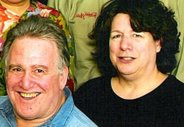
Darrow Hozian

(Photo Description: Darrow smiling at the camera. Note the red bandanna he has on his left arm at the bottom of the picture; the bandannas served as our Action Team "colors" at last year's disability rights/independent living conference.)

I first met Darrow Hozian at the office of the Coalition of Citizens with Disabilities in Illinois. I had just been hired and a major part of my duties was to write, publish and mail "The Catalyst", our monthly newsletter. When my first issue was completed and the printer delivered them to the CCDI office to mail to our membership, I had no idea what to do.

Luckily, for me, Darrow and his long time partner Janice Faulstich, had volunteered to do CCDI’s mass mailings a long time before me. They knew what to do. They knew how to sort the 1800 addresses by zip code and which zip codes went in rubber bands with which other. I was so glad to be working with them. It wasn't all that easy either.

Both Darrow and Janice had Cerebral Palsy; I had a hard time understanding what they were saying. Sometimes, they would get as frustrated with me as I would be frustrated with myself. But, we worked well together for two years and liked and respected each other. The Coalition office isn’t the same since Darrow and Janice no longer volunteer their labor there.

Darrow was an individual of tremendous strength and good will. He and Janice’s phone number were at the top of many people with disabilities phone list. If someone's personal assistant didn't show up or someone needed additional help, Darrow was there. If he wasn't Janice was.

Last week we heard from Janice that Darrow was in Intensive Care. This was the second time in the last several months Darrow was admitted to the ICU. I guess we were in denial. It was difficult to imagine someone of Darrow’s strength life being threatened.

On Friday, January 9, Janice got off the elevator at the ICU and knew that Darrow had passed.

Darrow and Janice; it is hard to say one name without the other. But, each has their own identity. They agreed on many things but, like all couples, had their disagreements too. Janice is looking forward to returning home and volunteer for even more tasks. She might even look for a job.

JoAnn Bayer and Darrow Hozian both died in the first two weeks of the New Year. How sad for all of us whose lives have been touched by them. How sad for the Disability Rights Movement to lose two of our shining stars. How important it is for the rest of us to do our best to find dozens of replacements for each leader we have lost.

Cilla (BigNoise) also wrote about Darrow today. You can read her column here.

Sunday, September 16, 2007

AFSCME: Lost Its Way

The American Federation of State, County and Municipal Employees (AFSCME) is a union with a proud history. It led the way in actively organizing Black people. It battled for workers who were legally forbidden to unionize. It inspired many with its spirited struggles.

Dr. Martin Luther King made his “I have a dream” speech amidst proud AFSCME workers. Dr. King gave his life supporting AFSCME members on strike in Memphis, Tennessee. Clearly, AFSCME made its mark standing with people of color and others on the outside of the predominant society.

September 12, 2007, ADAPT, a national organization of people with disabilities (PWDs) shut down the Illinois headquarters of AFSCME.

So What’s the Problem?

Why would an organization that represents the interests of people on the outside of society shutdown the headquarters of an organization that has a history of representing people also on the outside?

People with disabilities have always been excluded from the mainstream of society. Until the middle of the nineteenth century PWD’s were hidden in attics, sent out to beg, or left to die of neglect. Reformers encouraged the establishment of institutions for PWDs, where they could live and perhaps receive medical care. For 100 years, institutionalization was the primary way people with disabilities were treated. Inspired by the civil rights struggles of the late 1950’-early 1960’s, PWDs started agitating for their own rights. Among these rights were to live independently, outside of institutions.

There were and still are powerful forces that resist closing institutions. You have the owners and other people who make a living from these institutions; Doctors who commit people to places where they hold a financial stake. Then there is AFSCME.

AFSCME members spilled blood organizing the low paid and underappreciated workers. They succeeded in raising the pay and standard of living of these workers. But now, they perceive the job security of these employees and dues paying members in jeopardy by the struggle of PWDs to escape the claws of the institution.

“Hey Hey, Ho Ho, Institutions Have to Go”

AFSCME’s reputation is at stake.

Not only does AFSCME want to keep these monuments to the nineteenth century open; they even want to increase funding to these places where people are held against their will (interesting, AFSCME represents a large number of prison guards as well).

AFSCME refuses to support legislation to increase spending on home and community based services for PWDs. Henry Bayer, the leader of AFSCME in Illinois pledged his support for more federal spending on community care if ADAPT would agree to fight for MORE funding for institutions! AFSCME lobbied long and hard that institutions such as the Lincoln Developmental Center in Lincoln, Illinois and Bellfontaine in St. Louis, Missouri, remain open.

AFSCME does not see PWDs as human beings. To them, we are a source of jobs. More jobs will result in creating community settings for people with disabilities, not less. But AFSCME cannot see that. Instead of hanging on to an outmoded, demeaning, and shameful model of treating PWDs, AFSCME should be looking to the future.

AFSCME is leading other organizations who should know better. “Jobs with Justice” uncritically supports the institutionalization of PWDs. Their justification for this is supporting AFSCME members job security over the freedom for those incarcerated in state institutions.

Sadly, the leadership of AFSCME is exposing its back pedaling on basic trade union issues.

AFSCME is throwing away its militant history along with its progressive principles.

How many times has the AFSCME rank and file heard these words?

“…we could accomplish more by finding common ground and being productive rather than being divisive and confrontational.”

This is not management talking. This is AFSCME’s whining about the ADAPT demonstration.

Martin Luther King, III spoke at a national meeting of ADAPT several years ago. He spoke of the history of the Civil Rights Movement and compared it to the struggle of PWDs. His message: “Our struggles are entwined”.

Randy Alexander, Memphis ADAPT Organizer said of AFSCME;

"For an organization that has its roots in the civil rights movement, their treatment of people with disabilities is even more despicable. The union and its members make a lot of money by advocating keeping people with disabilities and older folks stuck in nursing homes and other institutions instead of being able to live in their own homes like other people. It's unconscionable that the union fights for workers' rights at the expense of our rights. In ADAPT, we know that you can't have one without the other."

AFSCME can no be considered a progressive organization as long as it stands in the doorway of progress.

Sunday, July 1, 2007

Savoring our Victories:

The following was written in August of 2006 for the newsletter of the Coalition of Citizens with Disabilities in Illinois (CCDI). It concerned actions organized by the Campaign for Real Choice, led by Lester and Barbara Pritchart at the Illinois State Fair during Republican and Democratic day festivities. The Campaign for Real Choice advocates for the shutting down of State Institutions housing People with Disabilities.

Savoring Our Victories: A personal testimony from an advocate who took part in the Freedom Days rallies.

By Michael Meiselman, CCDI Lifetime Member

It was hot and uncomfortable. Nearly a hundred disability rights activists were surrounded by thousands of Democrats - it was Democrat day at the Illinois State Fair. We were wearing bright yellow t-shirts. The Democrats wore blue. We arrived two hours before the program was to start to ensure front row seats. We went to provide witness of our commitment to see our brothers and sisters freed from the yoke of state operated institutions. The Democrats were there for a photo opportunity for the upcoming campaign. As the buses carrying the party faithful arrived, more blue shirts surrounded us. Individuals carrying signs snaked into our midst. We moved our chairs, blankets and support dogs closer.

One hundred or so young African American people were led to fill the gap between the stage and us. If we were going to be able to keep our ground and make our statement, we were going to have to fight. Union leaders and party functionaries gave their marching orders to their troops: Occupy the area in front of the stage so the photographs would show a wall of support for the leaders of the Democratic Party. Slowly, our resistance began. Shoulders moved together, powerchairs inched forward. The stronger we became the weaker and more uncertain they became. Their leaders caucused while the yellow shirts became bolder in defending our rights and turf. We cheered as one of our own loudly lectured the blue shirts saying we weren't going to allow our issues to disappear.

The blue shirts started leaving. We could hardly believe it. Save for a few they were leaving the areas they had once infiltrated! One of the blue shirted leaders even asked if he could wear our yellow shirt. It was a rout! We looked at each other with pride. Those with arms high-fived each other!

Most of us rarely enjoy the power and purpose that we felt. We won. Our leaders, as good as they are didn't negotiate this victory. We didn't win in court. We won as a result of a ragtag action army.

The next day was Republican Day. We still had our yellow shirts - they had sport shirts and golf pants. Again, we showed up two hours early to take our position at the front of the stage. However, they would not let us in. Admission was by ticket only. We lined up in front of the entrance. They learned their lesson from the day before and soon we were welcomed guests enjoying front row access. In addition the Republican leadership agreed to meet with our leaders to discuss the issues.

It's a couple of days later, and I know a lot of us are still smiling. We are thinking of the young and powerful blue shirts complaining about being grabbed, yelled at (often in a language they couldn't understand) and being nudged by wheelchairs. We are thinking how our yellow shirt's held onto our turf! We are thinking of how fast the politicians caved to our moral authority.

This is the glory of building movements. To savor the victories together, however small, that comes from the passion, action and the unity of individuals.

Tuesday, June 12, 2007

Disability and the Left, Part Deux

Note: This article is a reaction to a paper by Bill Fletcher, Jr. You can read it here.

I want to thank Bill Fletcher, Jr. for his recent note concerning mental health concerns. Coming from an individual as well respected as Brother Fletcher I hope his message will not be lost.

Yet even a person as respected as Bill has to start his paper on mental health by asking people to take what he says seriously…to hear him out before laughing.

Mental illness, cognitive and physical disabilities have not and are not taken seriously by the left. In fact, most all on the left do not see any place for people with disabilities (PWDs) except as wards of the state.

Last year at the annual meeting of Jobs with Justice in St. Louis the National Action planned a demonstration in favor of keeping a state institution for people with disabilities open. One of Jobs with Justice’s major supporters, AFCSME, wants to keep these state run institutions open as the employees are AFSCME members. When challenged whether this was in the best interest of the residents, comrades and friends deferred to a parent’s organization that supported the institutionalization of their children. Parents often do not represent the wants and needs of their children, disabled or not. But, one can hardly fault the parents for their thinking. The financial and emotional stigma attached to raising children with severe disabilities is multiplied by the lack of supports available for the care takers. Unfortunately, AFSCME’s interest and the interests of some parents took precedent over the desires and needs of the prisoners in these state institutions. No one contacted the residents, nor were any disability advocacy organizations, it was enough to get some parents approval.

Locking people with disabilities up in institutions has a history. The initial establishment of these institutions was progressive. Now they have become regressive. In the 1960s, faced with shrinking budgets, many state institutions were closed and the residents kicked out with no supports whatsoever. These closings and evictions had nothing to do with the welfare of the people with disabilities. They were simply measure taken in accord with capitalism. Economically they were unable to justify their existence.

We know now, however, that the overwhelming numbers of people with disabilities thrive outside traditional state institutions when they receive appropriate supports. In fact, a major goal of the disability rights movement is implementing “Olmstead” legislation (after a Supreme Court Cast of a couple of years ago). The Olmstead decision orders that money spent on an individual incarceration in a state institution should follow each person into the community and appropriate supports follow them.

The upsurge in the struggle for the civil rights of Black people in the ‘50’s and ‘60’s inspired many liberation movements. PWDs were also inspired. Berkeley, California gave rise to the Independent Living Movement. First fighting to gain admittance to the University and then facing many hurdles in being able to attend classes, people with disabilities took on the Administration and the attitudes of the campus community. Inspired by their success, Independent Living movements sprang up all across the USA. People in wheelchairs and their supporters took on public transportation. Chaining themselves to busses in cities from San Francisco, to Chicago, to Boston, access to so-called public transportation began to increase. In state after state, city after city struggles such as to make voting stations accessible, to allow people with disabilities to attend court without the humiliation of being carried up flights of stairs, for an end to segregated schools. People with disabilities fought for basic democratic rights. We support the struggle for Democratic Rights. We are active participants in many such struggles. For the most part though, we are absent from the struggles of PWDs. Why are PWDs fighting these struggles without the broad support of a concerned people? Because of the stigma attached to people with disabilities. It’s similar to white skin privilege. “At least I have it better than that poor soul” is what we say when we send money in to “Jerry’s kids” every Labor Day. We look at people with deformities, developmental disabilities, injuries and illnesses and turn away.

Today, especially after the tragedy at Virginia Tech there is more fear being spread about how dangerous people with disabilities are along with cries that more people need to be housed in state run institutions as a matter of public safety. Increasing louder voices call for preventive detention for people with mental disorders. Where is the left in opposing democratic rights?

I know there are revolutionaries and progressives who work with PWDs. I know there are progressives working with SEIU and AFSCME or are trying to organize the workers who serve PWDs. We should be uniting with the aspirations of the people who we work for and be very careful about the unity we have with those who profit off the institutionalization of PWDs.

I am not going to attempt a full-blown declaration concerning the disability rights movement here. It is long and complex. In fact, my own disability does not allow me the concentration needed to write much more.

Do some research. I suggest these books Nothing About Us Without Us: Disability Oppression and Empowerment by James I. Charlton, or Beyond Ramps: Disability at the End of the Social Contract by Marta Russell. Google Disability rights and see what comes up. Check out my wife’s blog, mybignoise.blogspot.com/

Saturday, April 28, 2007

New Orleans, Katrina and Race

“This place is going to look like Little SOMALIA.” That’s what Brig. Gen. Gary Jones, commander of the Louisiana National Guard’s Joint Task Force told Army Times on September 2nd... five days after Katrina hit New Orleans. “We’re going to go out and take this city back. This will be a combat operation to get this city under control.”

At the same time babies died for lack of milk. Older people died from exposure or dehydration. People with illnesses and/or disabilities died from a lack of medicine or treatments. People died from exposure. Families were torn apart with nothing in place to help them find one another. Too few busses arrive to carry people to relative safety.

Lieutenant General Steven Blum told reporters half of the troops had just returned from assignments overseas and are "highly proficient in the use of lethal force." He pledged to "put down" violence "in a quick and efficient manner."

When did New Orleans join the axis of evil? What did the primarily black citizens of New Orleans do to be compared to Somalia? Did we really expect the National Guard attack the survivors of this American tragedy? Don’t we believe the National Guard’s role is to protect and defend not create a military state for the innocent?

Of course, New Orleans needs to be safe and protected from the criminal elements that exist there. But, is this why the rescue mission was so delayed? The numbers of criminals are quite small compare to the throngs of displaced, law-abiding people. They could have done both simultaneously as they are doing now.

The National Guard should have been in New Orleans before the hurricane with amphibious vehicles, MREs, water and medicine. The National Guard should have been evacuating the victims of Katrina before she hit landfall. Federal, state and local officials knew the threat, knew that the levee was vulnerable, that the poor had no way to get out of its path, and knew Katrina was hurricane of their nightmares. Yet they did so little. Why?

Officials continue to receive a lot of criticism for not having a plan. But they did. The poor, elderly and disabled were to either stay and ride it out, or go to the superdome. We watched an interview with the head of emergency services as people flocked into the Superdome before Katrina made landfall. A reporter asked him about the services the people were going to receive. He said he was there to house them… not to feed them. You see, that was the plan. They made that plan despite knowing how fragile the levee was, despite the mock disaster failure.

There were no plans for food, for meeting hygienic needs, for keeping families together or anything else. That is the kind of planning that officials make for poor and other disenfranchised. The displaced know it and it’s why they are angry. You would be too.

When Katrina peeled the roof off the superdome, she exposed the ugly, hypocritical lie of American equality. Who was left? People who are poor, disabled, and of color. They know why it took five days for government to make a footprint at the convention center and other places where people were herded. They know that, in this society, they do not matter.

It’s not often that mainstream America gets to see what happens to people who fall through the safety net. It is ugly and horrifying. The institutional racism, and discrimination exposed by Katrina should make us realize that we have become complacent. We still have much to do to make America what it should be.

What is happening evokes in us some of the same feelings we had in the ‘60s when we saw young black people bitten by dogs, tear-gassed and attacked with fire hoses. The civil rights movement truly took on a national character when we saw what was happening in the south back then. What’s happening in New Orleans today stirs within us the same emotions and disbelief. And again, white people are shocked at the disparity, and have trouble accepting what is happening right here in America.

Let’s not forget these feelings, because the fight against injustice continues. Nationally, it continues as we continue to look for the living and the dead in the gulf coast, it continues as we discuss the reauthorization of the Voting Rights Act and the Americans with Disabilities Act. Locally, it continues when city officials fail to meet consent decrees. It continues when bond issues for new school are up for a vote. And, it continues when your neighbors deny a small group of disabled people a home in your neighborhood.